Simple Engineering Software
What is ProofStress
ProofStress is a free, web-based tool for building and verifying casing designs for oil & gas wells.
It's early in development, but already carries a robust basis for the key drilling and production loads — Burst, Collapse, Axial, and Triaxial checks. It also carries a capable thermal-load and APB (annular pressure build-up) model — trapped-annulus pressure, multi-annulus ballooning relief, and temperature-dependent fluids — though, as the newest area, it's still worth a sanity check.
The ambition is to keep building it out, and help from your side is welcome.
As the header says, it's built by a senior drilling engineer — not a programmer, not a professor, not a team. It may lack breadth, but it carries the soul of engineering and a hard-won understanding of the day-to-day work, and the friction of the dated, clumsy casing-design tools most of us still put up with.
Found a bug, missing a load case you need, or got an idea? Get in touch at [email protected].
Behind the curtains
I'm a senior drilling engineer with over twelve years in operations — most of it with an international operator, which threw a bit of everything my way.
Over the years that's meant casing design across the spectrum: deviated and horizontal wells, subsea and dry wellheads, wells drilled subsea then tied back to surface as dry completions, deepwater wells with complex APB mitigation, HP wells, conductor drives, jetting and drill-and-drive — alongside hanger evaluation and the less glamorous work: assessing tired old strings that have had sidetrack after sidetrack drilled through them, and picking apart casing failures after the fact.
ProofStress started almost by accident — I set out to see how much I could build with an LLM at my side, and it grew arms and legs. But the engineering underneath isn't borrowed from a chatbot: the core physics is built from my own experience and from publicly available drilling-engineering and casing-design resources — the standards and texts we all work from. The disclaimer still applies, though — check every result.
A big operator probably won't have much use for it. But if you're at a small company, or on your own, and still wrestling complex casing design in a tangle of Excel spreadsheets — this is for you.
A few simple steps
It all starts with the inputs
A good design starts with the right inputs. ProofStress is built to make laying out your well as quick and organized as possible — no clicking through nested menus, no fighting the tool, just a few clear steps that follow how you'd actually think about the well.
Lay out your strings — casing, liners, tiebacks, hangers, connections and other proprietary components — and watch the schematic draw itself to scale as you go, so you can take in the whole well at a glance and catch a wrong shoe depth or an overlap before it costs you.
Then layer in what the loads will need: survey stations, pore-pressure and fracture gradients, temperature and fluid profiles. Already have it in a spreadsheet? Paste it straight in — every one of those takes a direct copy-paste from Excel, CSV or plain text, so there's no retyping rows by hand.

Define each load case
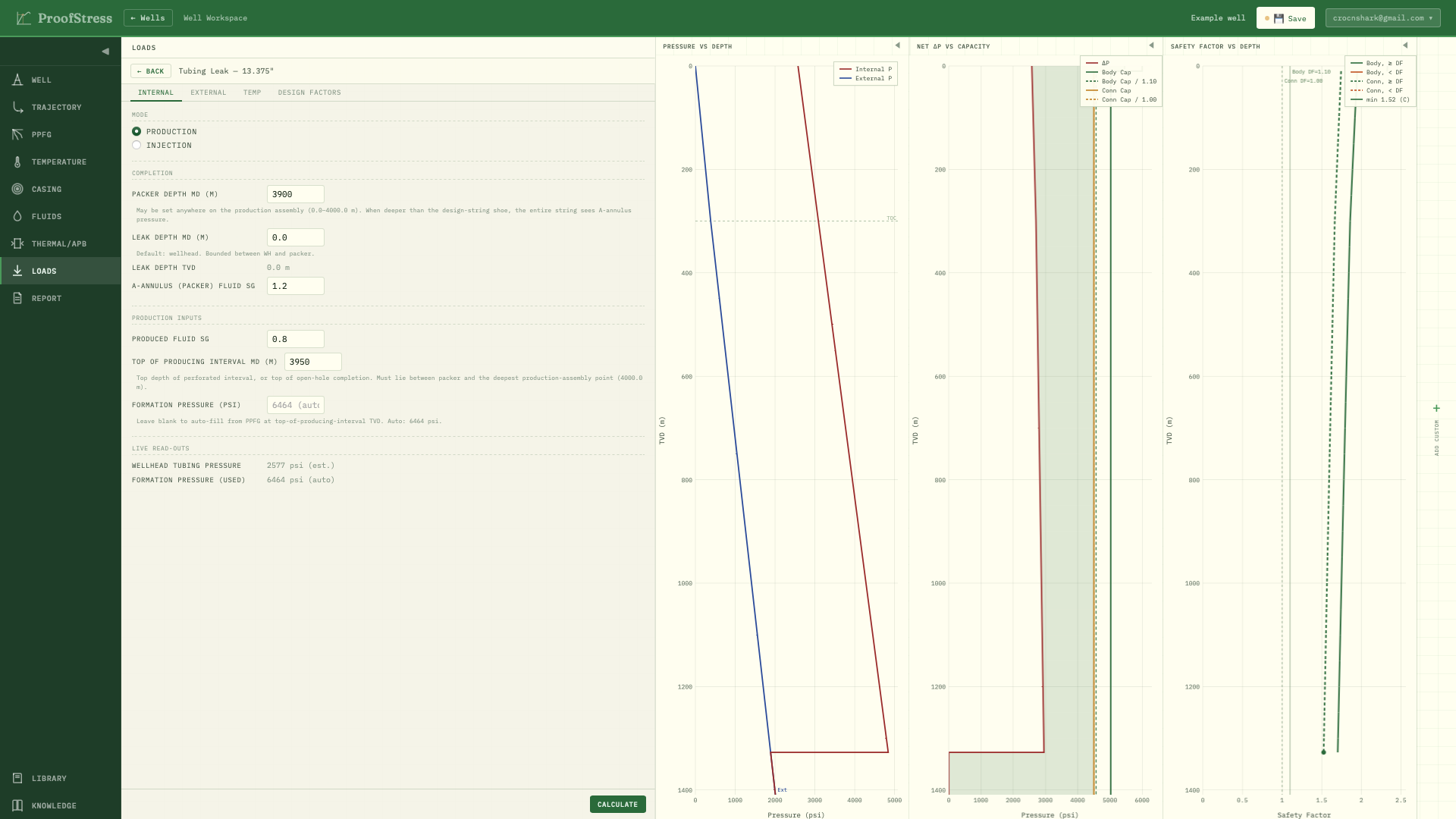
Every string has to survive a set of loads. Build them one at a time — burst, collapse and axial scenarios drawn from the real drilling and production situations a string actually sees, from cementing and pressure tests to gas kicks, tubing leaks and running loads — and set only the inputs that matter for each.
ProofStress works out the full pressure or force profile down the string and checks it against the pipe's ratings — body and connection — so you get the safety factor at every depth, not just a single headline number. Change an input and the profile and its plots move with it, so you see straight away what your decision did.
Compare every load at once
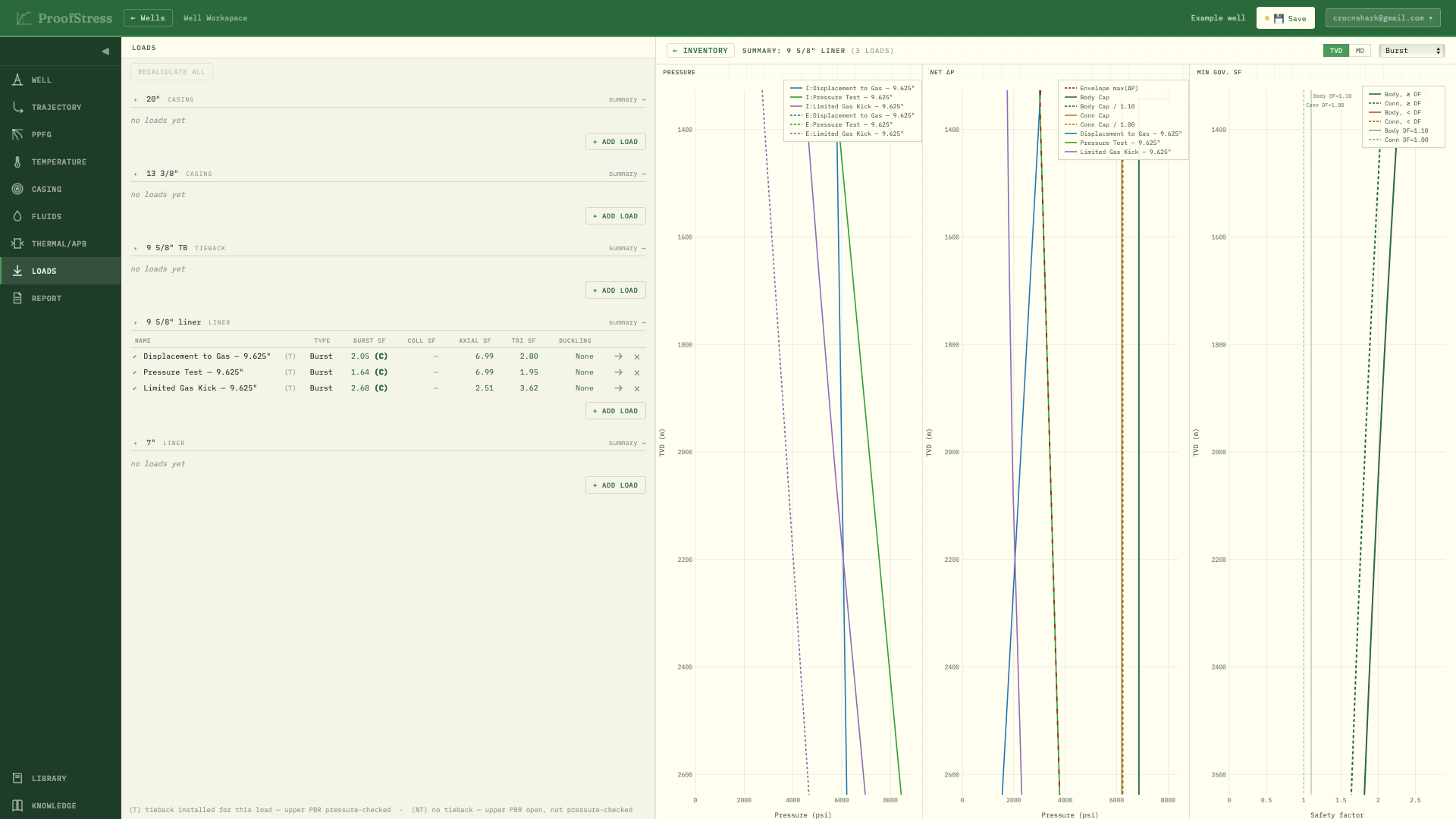
With your cases built, the loads view brings them together by type — every burst case on one plot, every collapse on another, axial and triaxial alongside — so the full design envelope is in front of you at once.
It's easy to see which case governs at each depth and where the design runs tightest, so you know exactly what's driving your weights, grades and connections — and where you've still got margin to optimize.